

Our History
Wild Oceans was founded in 1973 as the National Coalition for Marine Conservation (NCMC). For over fifty years we have been bringing people together to make sure there will always be plenty of fish in the sea. Our experience, long track record of achievement, and willingness to take tough stands backed by the facts, have earned us an influential role in shaping regional, national, and international policy.
The founding years 1973–1992
-
1973
Founded by fishermen
“Swordfishing on Nantucket Shoals and Georges Bank made me aware of the tremendously destructive fishery being prosecuted by foreign vessels and the need to establish a 200-mile-limit.”Chris Weld, NCMC co-founder
Weld, who fished extensively for swordfish, bluefin tuna, marlin, and sailfish, recalls that no conservation organizations were then dedicated to fishery issues. With Frank Carlton and the encouragement of others, he incorporated NCMC as a non-profit.
NCMC’s first action was to convene the organizers of 40 major fishing tournaments to encourage catch-and-release fishing. Its first two programs focused on bluefin tuna conservation and on establishing a 200-mile limit. The first led to work with ICCAT, the international body that manages Atlantic tunas; Carlton was one of the first U.S. Commissioners to it. The second led to the drafting of the original Magnuson Fishery Conservation and Management Act of 1976, which established federal authority to manage and conserve the nation’s fishery resources.

-
1980–1984
Atlantic striped bass
In 1980 NCMC hosted a Striped Bass Symposium, mainly to examine how environmental changes contributed to the fish’s disappearance. NCMC then worked with the Atlantic States Marine Fisheries Commission (ASMFC) on a management plan, which led to the Atlantic Striped Bass Conservation Act of 1984 and put the iconic striped bass on the road to recovery.

-
1985–1990
Atlantic billfish management plan
The federal plan for conserving Atlantic billfish began in 1985. NCMC worked to make maintaining an abundance of blue and white marlin and sailfish for recreational fishing a primary goal. The social and economic value of catch-and-release fishing far outweighs any commercial value and has a negligible effect on the stock.
Billfish were also being caught incidentally in expanding U.S. pelagic longline fisheries, and a commercial market for marlin was emerging in the U.S. NCMC saw a ban on sales as the most effective tool available, because it removes the incentive to target or land billfish for commerce. The no-sale plan became law in 1990, helping protect the future of billfishing in the Atlantic.

-
1987–1989
International Billfish Symposium
To build global cooperation on conserving wide-ranging marlin and swordfish, NCMC sponsored an International Billfish Symposium in Kona, Hawaii, in 1988. It drew 160 scientists, managers, conservationists, and fishermen from 15 countries. Sixty papers covered fishery trends, population status, research needs, and management strategies, and NCMC published them, with the panel discussions, in two hardcover volumes the following year.
For organizing the conference, NCMC’s Ken Hinman received The Billfish Foundation’s Conservation Award in November 1988.

-
1988–1990
Bringing tuna under the Magnuson Act
The original Magnuson Act excluded tuna, putting tuna stocks and other big fish at risk. NCMC led a drive to repeal the exclusion and extend conservation and management to tuna fisheries, testifying before Congress and meeting with staff. In October 1990, lawmakers gave U.S. managers authority to manage tuna and regulate tuna-fishing bycatch.

Longlines, sharks, and the Pacific 1993–2000
-
1993–2000
East Coast and Gulf longline closures
In 2000 the National Marine Fisheries Service (NMFS) closed 133,000 square miles of U.S. coastal waters to longlining. The effort began in 1993, when NCMC co-founded the Marine Fish Conservation Network, and continued through the 1996 Magnuson Act amendments, which made bycatch reduction a mandate.
NCMC’s 1998 report, Ocean Roulette, recommended closing high-bycatch areas. A 1999 settlement secured large closed areas off the southeast coast and in the Gulf of Mexico, reducing billfish bycatch by up to 75 percent and helping restore swordfish on the East Coast.

-
1993–2011
Shark conservation and the finning ban
In 1993 NMFS adopted a fishery management plan for 39 Atlantic shark species. NCMC helped persuade Congress to pass the Shark Finning Prohibition Act of 2000, then helped close a loophole with the Shark Conservation Act of 2011. That law requires sharks to be landed with their fins naturally attached and allows sanctions on nations without consistent shark-fishing regulations.

-
1996
“Getting Ahead of the Curve” in the Pacific
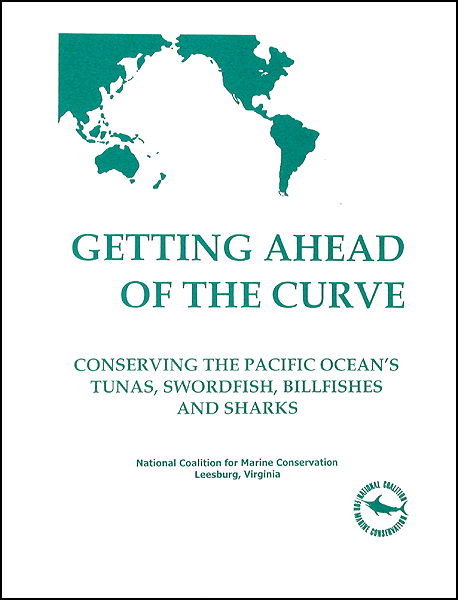
In November 1996 NCMC brought more than 130 fishery experts, scientists, managers, fishermen, and conservationists to Monterey, California, for a symposium on ocean-wide conservation of highly migratory fish. It recommended ratifying the UN Agreement on Highly Migratory Fish Stocks, improving coordination among regional fisheries commissions, extending treaties to billfish and sharks, and using multilateral trade measures to enforce international agreements.
-
1999–2000
Conservation in a Fish-Eat-Fish World
After the EPAP report, NCMC organized a workshop on managing predator and prey species together. It invited policy makers and scientists from NMFS, the New England and Mid-Atlantic Fishery Management Councils, and the ASMFC. A year later NCMC published the proceedings as Conservation in a Fish-Eat-Fish World.
Along with general recommendations for changing fishery management plans to assess fishing’s effects on other species in the food web, the report used Atlantic menhaden as a case study. It suggested specific changes to protect menhaden’s main predators, most notably striped bass.

Forage fish and new fronts 2000–2011
-
2000–2005
Protecting pelagic sargassum
NCMC pushed for a federal Pelagic Sargassum Plan to prevent commercial exploitation of the brown algae that provides critical habitat for many ocean species off the southeastern U.S. It also worked to strengthen the U.S. position that sargassum is essential habitat on the high seas, in the Sargasso Sea.
Working with the South Atlantic Council, NCMC got a U.S. ban on commercial harvest approved in 2004. In 2005 it drafted a protection resolution, convinced the U.S. to sponsor it at the ICCAT meeting, and won a place on the U.S. delegation to guide it through the 44-country body.

-
2001–2004
West Coast highly migratory species plan
In 2001 the Pacific Council began its first management plan for swordfish, tunas, marlin, and sharks off the West Coast. NCMC helped make a ban on longlining in federal waters its centerpiece. Enacted in 2004, the plan also included data collection, drift-net restrictions, a ban on striped marlin sales, and shark catch limits.

-
2003–2005
A petition to save menhaden: “Menhaden Matter”
In 2003 NCMC circulated a petition to curb industrial netting of menhaden in Chesapeake Bay and gathered close to 5,000 signatures. It took the petition to the ASMFC’s annual meeting that December and was invited to present a 9-page paper documenting menhaden’s decline and its effect on predators to the Menhaden Management Board, urging the board to begin amending its interstate management plan. The board referred the paper to its scientific advisors. What followed:
- April 2004: NCMC formed Menhaden Matter with the Chesapeake Bay Foundation, Coastal Conservation Association, and Environmental Defense.
- October 2004: The ASMFC held a three-day scientific workshop on menhaden’s ecological status, with emphasis on its role as forage in Chesapeake Bay.
- August 2005: The ASMFC voted to cap industrial harvest in Chesapeake Bay for five years.
The cap was a precautionary freeze meant to prevent any increase in the bay catch and to give researchers time to examine concerns that a shortage of menhaden was harming striped bass on their main East Coast spawning ground. During this “timeout,” NCMC led efforts to change menhaden science and management to account for its importance as forage, and has taken part in virtually every menhaden meeting and workshop since 2006.

-
2005–2012
Protecting the West Coast forage base
NCMC’s work at the Pacific Council began in 2006 with an amendment to the Coastal Pelagic Species (CPS) plan to prohibit krill harvest, which NMFS approved in 2009. That reinforced NCMC’s request that the council turn the CPS plan, which covers sardine, mackerel, anchovy, squid, and krill, into a true forage fish plan.
In 2008–09 NCMC helped develop a West Coast forage fish project run by the Point Reyes Bird Observatory’s Conservation Science program. Pam Gromen served on the steering committee and helped write the report Ecosystem-Based Management of West Coast Forage Species, which NCMC and PRBO presented to the council in June 2009. They asked the council to account more fully for predators’ needs when setting annual catch limits and to monitor other important, unmanaged forage fish. The council agreed to reevaluate sardine harvest guidelines and to add more species to the plan, so far Pacific herring and jack smelt. NCMC also began working with the council on a Fishery Ecosystem Plan (FEP) to set a baseline for a healthy West Coast forage base.
In June 2012 the council approved a draft FEP for adoption in early 2013 and an outline for an annual State of the California Current Ecosystem Report. It also declared a goal of prohibiting new fisheries for currently unmanaged forage species.

-
2006
Taking the Bait and Forage First!
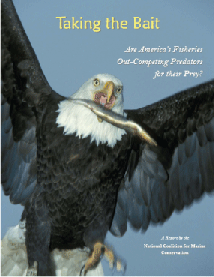
In 2005–06 NCMC analyzed three federal fishery management plans for key forage species in New England, the Mid-Atlantic, and the Pacific. The results appeared in Taking the Bait: Are America’s Fisheries Out-Competing Predators for their Prey?, which launched NCMC’s national Forage First! campaign. It recommended amending plans to account for and protect a forage base for predators, and went to all council members and staff and to national and regional fishing and conservation groups.
The report’s author, NCMC executive director Pam Lyons Gromen, led Forage First!, presenting with Ken Hinman at council meetings, to other groups and at workshops on both coasts. Its four-step blueprint for amending forage fish plans to account for predator/prey relationships, and to put protecting them ahead of allocation to fisheries, was widely adopted by other organizations as a model.
-
2006–2011
Stricter criteria for certifying forage fisheries
In 2006 the Marine Stewardship Council (MSC) announced it was assessing the Gulf of California sardine fishery, the first feed-grade, or reduction, fishery to apply for its “sustainable” label, and called on other reduction fisheries to follow. NCMC saw a potential disaster. Aquaculture’s heavy dependence on wild-caught fish for feed is a recognized risk to marine ecosystems, and NCMC’s review of MSC’s methodology found major weaknesses: forage fisheries could earn the label with no safeguards for the ecosystem or dependent predators.
NCMC formally entered the sardine certification process with letters and detailed critiques, encouraged other groups to get involved, and met with MSC officials several times, urging them to “raise the bar.” MSC strengthened its forage fishery criteria in 2008 and agreed in 2009 to redo its West Coast sardine assessment. NCMC then submitted another evaluation showing the new scoring still did not protect the ecological role of sardine and other forage species. Later in 2009 MSC convened a Low Trophic Level Fisheries Workshop, which NCMC was invited to join, followed by a working group.
In August 2011 MSC adopted the group’s guidance, published in a peer-reviewed journal, which specifies the forage stock levels that must be maintained to protect the ecosystem. To earn a minimum passing score, a fishery must be kept at no less than 40% of its un-fished biomass.
-
2006–2012
Preserving the Northeast forage base
Using the Taking the Bait blueprint, NCMC began working in 2006 to amend the New England Council’s Atlantic herring plan. By the end of 2007 the plan had a new objective explicitly recognizing the importance of sea herring as prey, and the council had closed a near-shore area of the Gulf of Maine, where herring are scarce, to mid-water trawls.
NCMC also joined the new Herring Alliance, which began with nine regional and national groups and has since grown to more than 30, all with an interest in herring as prey for cod, haddock, bluefin tuna, whales, and seabirds.

-
2007–2009
A new national policy on forage fish
After the 2006 reauthorization of the Magnuson-Stevens Act, NCMC saw a chance to get forage fish conservation into NMFS’s revised National Standard 1 Guidelines, the agency’s rules for carrying out the Act. NCMC testified at hearings and submitted written comments urging NMFS to give the councils guidance on setting allowable catches in an ecosystem context. It also held a workshop with the Marine Fish Conservation Network, moderated by NCMC, whose findings shaped the technical guidance.
The guidelines that took effect in 2009 cite maintaining adequate forage for all components of the ecosystem as a goal in setting annual catch limits. They require each fishery management plan to address predator-prey interactions and other ecological factors when determining optimum yield, and they say species interactions can justify setting forage fish catch levels lower, and populations higher, than conventional management would.

-
2008–present
Strong standards for offshore aquaculture
Global aquaculture is the largest consumer of forage fish, which become meal and oil to feed farmed fish like salmon and tuna. Demand is expected to double as offshore aquaculture grows, adding pressure on ocean predators that compete for the same limited food.
Since 2008 NCMC has pressed for strong U.S. environmental standards for open-ocean fish farming, including limits on the use of wild fish as feed. A 2010 NOAA/Department of Agriculture report, The Future of Aquafeeds, reflected the concerns of NCMC and a diverse coalition, from the Pacific Coast Federation of Fishermen’s Associations to the Ocean Conservancy. It recognized the importance of pelagic forage fish to marine ecosystems and acknowledged that rising demand could encourage over-exploitation.
NCMC continues to weigh in with NOAA, commending its statement that aquaculture should be “in harmony with healthy, productive, and resilient marine ecosystems” while demanding mandatory permit conditions for offshore aquaculture that prevent harm to those ecosystems.

-
2008–present
Take Marlin Off the Menu
NCMC launched this campaign in 2008 with the International Game Fish Association (IGFA) to educate consumers about marlin’s threatened status and commercial over-exploitation. NCMC worked with restaurants and seafood retailers, including Wegmans Food Stores and chef Wolfgang Puck, to take the marlin-free pledge, and drafted national legislation to raise awareness.

-
2009
Ecological reference points for Atlantic menhaden
Since the Chesapeake Bay cap, NCMC has urged the ASMFC to set ecological reference points, meaning limits on fishing mortality and targets for stock abundance, to gauge menhaden’s status and guide management. In 2008 the commission asked its Management and Science Committee to explore new reference points. NCMC researched and submitted a scientific paper, Ecological Reference Points for Atlantic Menhaden, based on the scientific literature and on forage fishery management in the U.S. and abroad.
The committee’s chair supported the recommendations, and at the August 2009 Management Board meeting Maryland’s Department of Natural Resources moved to begin a new amendment to the menhaden plan in 2010 that would adopt reference points protecting menhaden as forage. The white paper called the existing reference points inadequate, a position an independent peer review panel affirmed a year later. Its recommended targets and limits, abundance at 75% of the unfished level and fishing mortality below natural mortality, were corroborated by the Marine Stewardship Council’s Low Trophic Level Task Force (2011) and the Lenfest Forage Fish Task Force (2012).

Wild Oceans today 2012–present
-
2012
Billfish Conservation Act
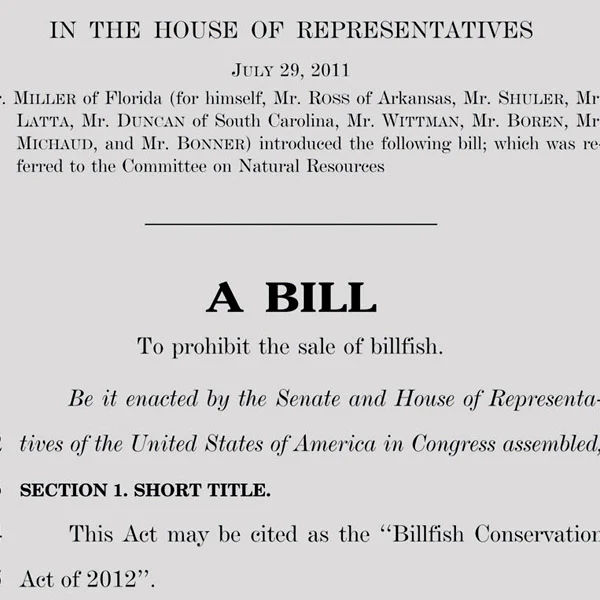
President Obama signed the Billfish Conservation Act of 2012 on October 5. It effectively bans importing billfish into the continental U.S. and was expected to end the sale of an estimated 30,000 marlin a year. NCMC, by then operating as Wild Oceans, and IGFA helped mobilize a coalition of angling and conservation organizations. For this work, Wild Oceans received the IGFA Conservation Award in January 2013.
-
2018
Billfish Conservation Act amendment
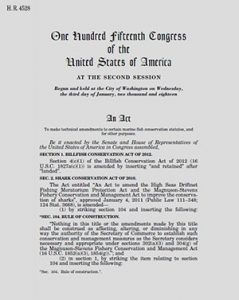
Congress passed, and President Trump signed, HR 4528, a technical amendment to the Billfish Conservation Act. It clarifies that Pacific billfish exempted from the Act’s federal no-sale provision may be sold only locally in Hawaii and Pacific island territories. This achieves the Act’s original intent of prohibiting billfish sales within the mainland U.S. while allowing a cultural tradition in the islands, the local sale and consumption of billfish, to continue.
-
2020
Congress phases out drift gillnets
Wild Oceans has been fighting for over 35 years to end the use of this destructive gear. A 1985 edition of its newsletter (formerly titled “The National Coalition for Marine Conservation Marine Bulletin”) cited the need for Congress to take strong action against unattended gillnets that result in the wasteful killing of target and non-target species, and the incidental entrapment of game fish, marine mammals, turtles, and other sea life. Needless to say, it’s been a long fight.
The Driftnet Modernization and Bycatch Reduction Act complements a 2018 California state law, which revokes state drift gillnet permits in 2024 and provides the few dozen current drift gillnet fishermen with financial assistance to switch to cleaner fishing gears. Commercial fishermen participating in the state transition program will be first in line for the opportunity to fish with innovative, selective swordfish gear known as deep-set buoy gear.

-
2020–present
The Florida Forage Fish Coalition
Wild Oceans is a proud partner in the Florida Forage Fish Coalition, whose partners support, promote, and communicate forage fish research to managers, stakeholders and the public. Funds raised through the Florida Forage Fish Research Program provide fellowships to graduate students at Florida universities who work with the Florida Fish and Wildlife Conservation Commission’s Fish and Wildlife Research Institute (FWRI).
The program produces high-quality research on the value of forage fish to predators and marine habitats, builds partnerships between academia and FWRI, and fosters the next generation of fisheries scientists.

-
2021–present
The Kona Project
The Wild Oceans Kona Project is a multi-year effort to improve understanding of billfish nursery grounds and use that knowledge to champion better protections. It has three parts: research, management, and education. Its goal is to inform conservation-based management strategies that lead to healthier billfish populations and better fishing for small-boat fishermen and anglers across the Pacific.

Help write the next chapter
Your gift keeps Wild Oceans working to conserve ocean fish and habitats.